


Description
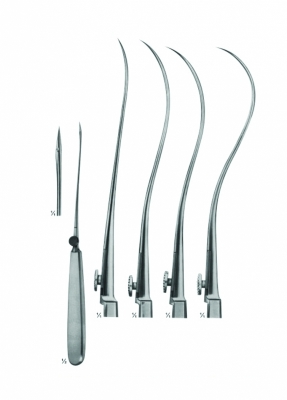
suture Instruments Reverdin Needles AE 02 3917 02 3920
suture Instruments Reverdin Needles AE 02 3917 02 3920
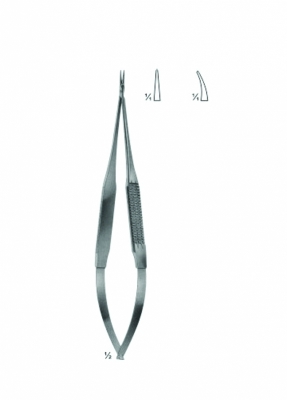
Reverdin Needles – AE 02-3917 & AE 02-3920
Design & Structure
suture Instruments Reverdin Needles AE 02 3917 02 3920
suture Instruments Reverdin Needles AE 02 3917 02 3920
suture Instruments Reverdin Needles AE 02 3917 02 3920
-
These Reverdin needles are part of a series of suture instruments (e.g. listed with codes “02-3917-02-3920”) used for deep or difficult suturing tasks. Allex International+1
-
They typically feature a sliding-eye mechanism near the handle, which allows the needle’s eye to open and close. This lets the surgeon pass the needle through tissue first and then thread the suture through the needle, rather than loading the suture beforehand. This design reduces tissue drag and reduces trauma during passage. (Standard for Reverdin type needles) Novo Surgical+1
-
Material is usually high-grade surgical stainless steel: corrosion resistant, autoclavable, durable under repeated sterilization. Surface finish is polished and smooth to allow easy passage through tissue.
Size & Curvature
-
While exact measurements for AE 02-3917 & AE 02-3920 are often not detailed explicitly in public spec sheets, they are grouped with similar Reverdin needles in catalogs such as “VI-02-3917-02-3920” in the Vitra or Allex International line. Vitra International+1
-
The curvature may vary among the two: one might be more sharply curved for tighter spaces, the other less so, to adapt to different anatomical situations.
Function & Applications
-
Used in surgical suturing where access is constrained or where minimal tissue disturbance is critical: e.g. abdominal, thoracic, vascular surgery, reconstructive & plastic surgery.
-
The sliding eye mechanism is particularly helpful when the suture itself is bulky or when visibility is limited: the needle can be passed first, then the thread inserted, which avoids pulling the thread through delicate tissues more than necessary.
-
Also useful in dental or oral maxillofacial surgery where suturing inside the mouth or near bony structures demands precision.
Advantages
-
Reduces tissue trauma and helps maintain better tissue integrity.
-
Enables more precise suture placement in deep or narrow fields.
-
Improves surgical efficiency by avoiding repeated threading or repositioning.
-
Reusable: good long-term cost effectiveness if properly sterilized and maintained.
Care & Handling
-
The sliding eye mechanism must be kept clean and lubricated (if applicable) to ensure smooth operation; debris or corrosion can jam the slide.
-
Regular inspection for sharpness of tip (if tip is sharp) and integrity of eye mechanism.
-
Sterilization protocols must be followed: autoclaving, drying, avoiding damage to sliding parts.
-
Use with appropriate curvature & size to match surgical site to avoid excessive bending or force.
Extracting Forceps
While you didn’t specify a model, general description applies to standard dental extracting forceps.
Description & Structure
-
Extraction forceps are instruments used in dental operations to firmly grasp a tooth or root to extract it from its socket. They are composed of two arms joined at a hinge, with handles, shank/intermediate portion, and the beaks or jaws.
-
The beaks are shaped and contoured to fit around the crown or root of a tooth; inside faces may be concave and often grooved/serrated to improve grip on the tooth surface and prevent slippage. Dentaltix+2DIT USA+2
-
The shank/neck (intermediate zone between beaks and handles) is shaped depending on whether the forceps is for upper or lower teeth. For upper teeth, the shank may be angled or bayonet shaped to allow better access; for lower teeth, straight or with an angle suited to jaw anatomy. Dentaltix
-
Handles are designed ergonomically, for grip comfort, control, and to allow sufficient leverage. The hinges (if screw or joint type) must be precise and strong.
Materials
-
Usually made from surgical stainless steel for strength, durability, sterilizability.
-
Surface finish is smooth; some may have matte or satin sections to avoid glare.
-
Some forceps have serrated or diamond‐coated inserts at beaks to improve grip.
Applications
-
For removal of teeth (decayed, damaged, non-restorable), impacted teeth, root tips.
-
In pediatric dentistry (smaller forceps), oral surgery.
-
Specialized forceps for upper molars, lower molars, incisors, canines, or root fragments. Choosing the correct type for the tooth position is critical to reduce damage.
Advantages & Key Features
-
Provide mechanical leverage to extract teeth with minimal trauma.
-
Proper beak design and grip minimizes risk of slippage, crown or root breakage.
-
Ergonomic handles reduce operator fatigue and improve control.
-
High strength to withstand extraction forces.
Considerations & Best Practices
-
Select the correct type (upper vs lower, molar vs root tip vs anterior) to match anatomy. Using a forceps with wrong angle or beak shape can lead to fractures of tooth or damage to surrounding bone.
-
Use incremental force; avoid twisting or jerking. Luxate and loosen before applying force.
-
Ensure beaks are clean, sharp (well-formed; not damaged), and joint/hinge works smoothly.
-
Sterilize properly; maintain hygiene to avoid cross-contamination.
- suture Instruments Reverdin Needles AE 02 3917 02 3920
-
Follow Us On Social Media Account
Reviews
There are no reviews yet.